At a glance
Worth evaluating for a team integrating US messaging that wants an itemized rate card and a shared messaging and Voice portal. Verify the sender approval, total bill and delivery workflow before migration.
Signal House
Best for: Businesses evaluating US application messaging; Developers able to test integration and monitor costs
A research-based Signal House review covering US messaging, portal controls, Voice, carrier fees and the checks to make before moving an SMS workload.
Strengths
- Published US rate card separates usage and carrier charges
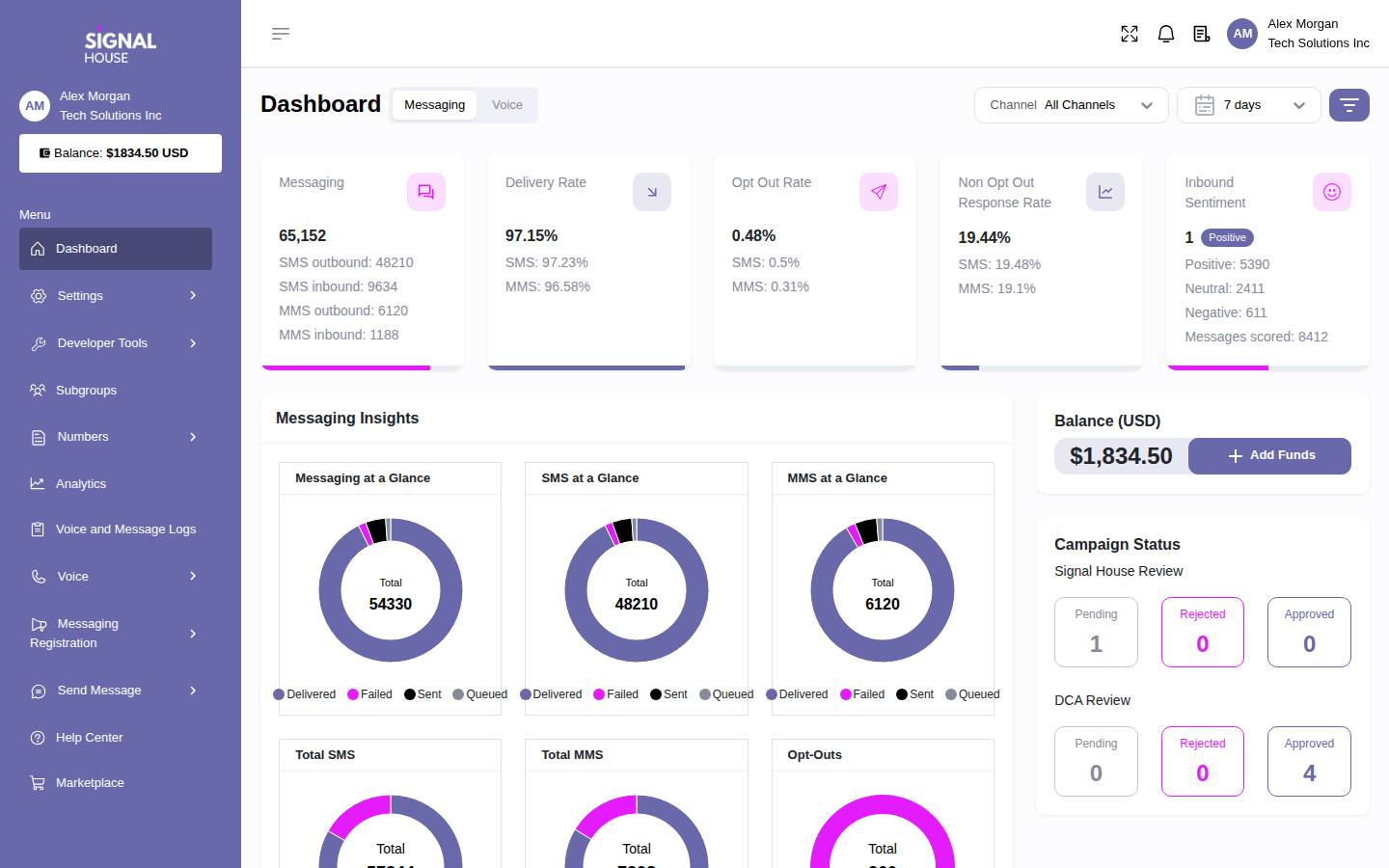
- Messaging dashboard and Voice settings are shown in official visuals
- Local, toll-free and short-code routes have separate pricing
Trade-offs
- A low usage rate is only part of the total cost
- Sender approval and implementation need planning
- No Pickora deliverability, support or savings benchmark
Pickora may earn a commission if you buy through this link. Read our disclosure.
A communications platform for an integration project
Signal House at signalhouse.io sells SMS, MMS and Voice capabilities for business applications. Its homepage emphasizes APIs and US sender options. Its messaging and calling products need to be evaluated for the exact workflow you intend to run.
Our assessment uses official product and pricing pages checked November 4, 2026. Pickora has not sent messages, placed calls, completed registration or measured support response time through a paid account. The interface images are vendor demonstrations; the displayed balances, volumes and delivery figures are not Pickora results.
Choose the sender before comparing the unit price
The official product overview separates local 10DLC, toll-free and short-code messaging. These are different sender choices, with their own number costs and verification paths. An existing local number can be relevant to a customer-service workflow, but availability and migration still need confirmation.
The 10DLC page describes application-to-person messaging using local ten-digit numbers in North America. It presents transactional and conversational use cases. Those descriptions help frame an evaluation; they do not mean a business can skip approval or use a number for any audience and content it chooses.
Ask the vendor about your exact business, sender, destination countries and message purpose before estimating a launch date. The US rate card is not evidence of European coverage or European pricing. An EU business contacting US customers still needs to establish the relevant account eligibility and processing arrangements.
The portal and the application do different work
The dashboard visual shows messaging metrics and account controls. A buyer should use that as a starting point for a demo, then ask how those views connect to the application’s own status records. A vendor delivery-rate display does not establish that the recipient read a message or completed a transaction.
The API product page describes documentation, SDKs and implementation support. We have not validated an integration from that marketing description. During evaluation, ask the technical team to demonstrate sending, inbound handling, status updates, errors and controlled retries with approved test numbers.
Voice has its own controls and billing
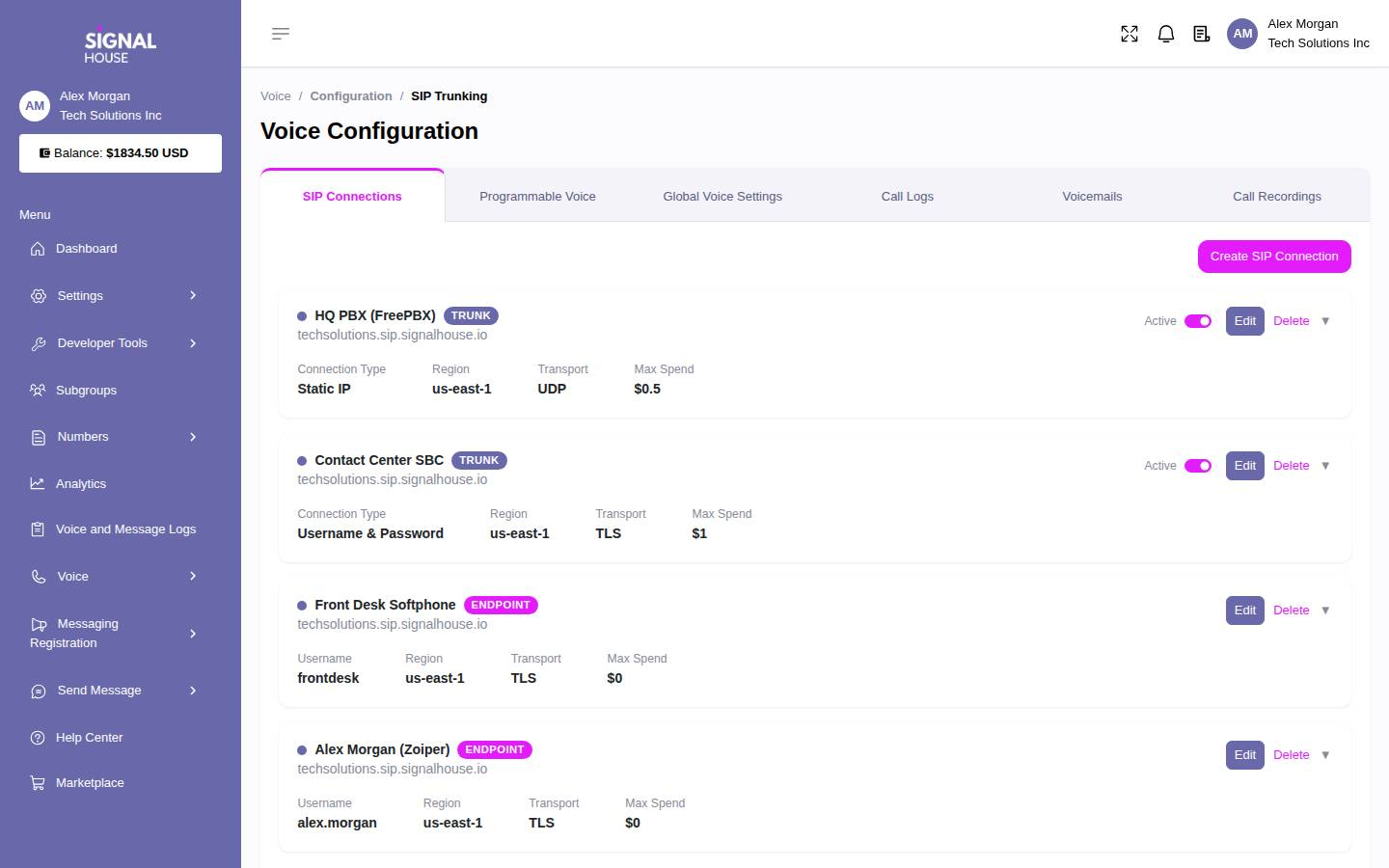
Vendor demonstration visual. Source: Signal House. This is not a Pickora test account.
The Voice page describes browser calling, programmable calls, SIP connections and call logs. Its portal visual shows SIP connections. These are specific capabilities to assess if calling is part of the project; they should not be inferred from an SMS price alone.
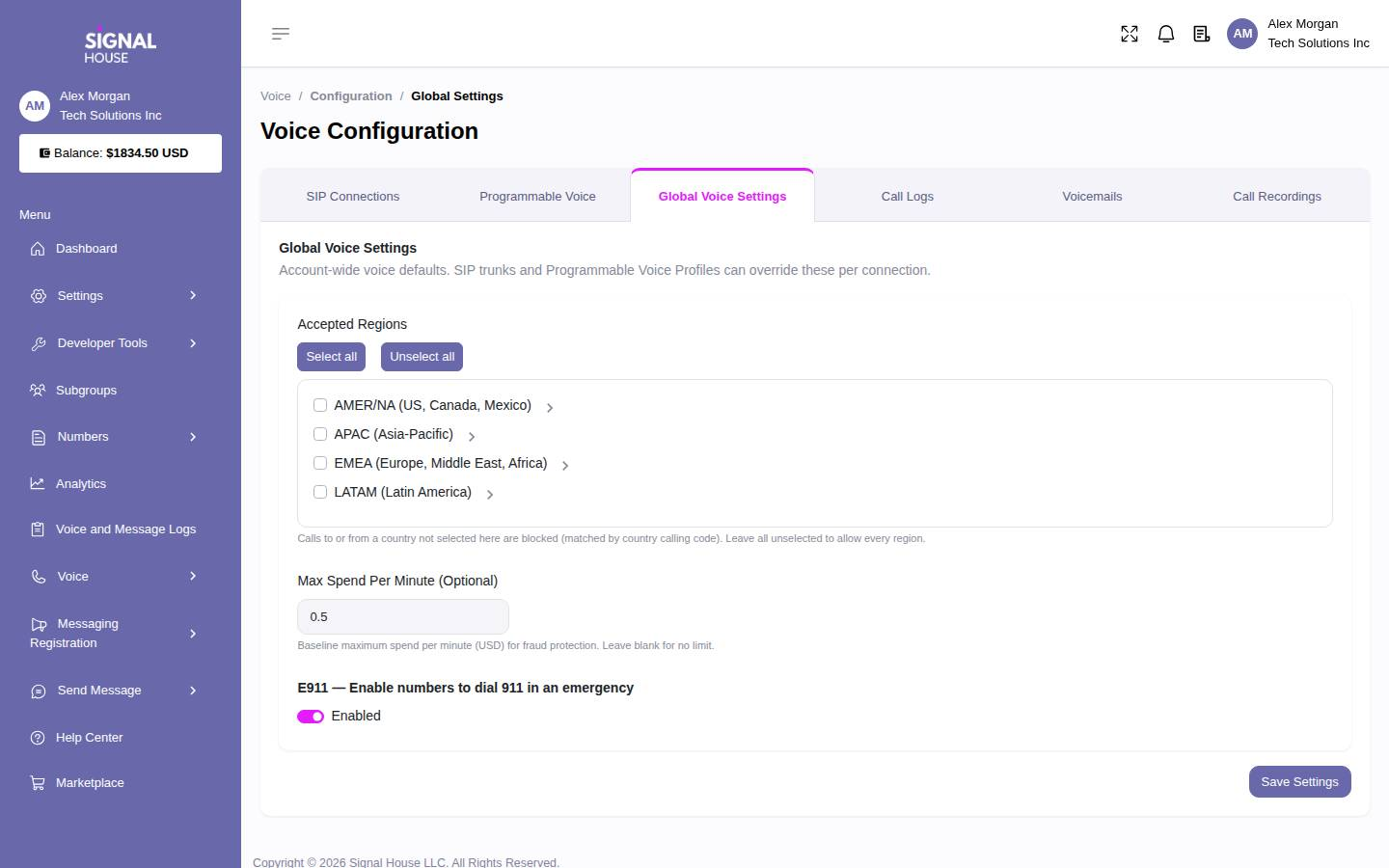
Vendor demonstration visual. Source: Signal House. This is not a Pickora test account.
The global-settings visual includes regional and spending controls. Ask how those settings apply to the connection you intend to use, and test the configured restrictions before scaling. The existence of a control in a vendor image does not verify its behavior in your account.
Cost: the base rate is not the final bill
The US pricing page lists a no-minimum local 10DLC outbound SMS rate of USD $0.0065 per segment and a local number at $1 per month. It separately lists outbound carrier charges, including $0.0035 for AT&T and $0.0045 for Verizon and T-Mobile. These are published rates checked on the source date, not an all-in quote.
Budget for actual segments, carrier mix, incoming traffic, numbers, registration and any taxes or other charges. Request a complete registration quote in writing; those setup and recurring charges are outside the usage rates above. Volume tiers and negotiated terms also need to match your workload.
Voice has separate per-minute pricing and rounding rules. The page says answered calls have a one-minute minimum and subsequent usage rounds up to the next minute; voicemail counts as answered. A budget based only on connected seconds can therefore miss billable usage.
What we would verify before switching
Begin with one approved use case and a small, permissioned sample. Compare application records, portal status and the actual recipient outcome. Inspect error handling, replies, suppression and the spend visible on the account. This is a proposed evaluation, not completed Pickora testing.
The homepage’s savings and deliverability figures are vendor marketing claims. We do not repeat them as measured results or promise that migrating from another provider will cut your bill by a particular percentage. Compare the same sender type, destinations, traffic pattern and support arrangement.
Signal House is a plausible shortlist candidate when a team can evaluate the integration and the whole cost structure. Choose after approval, billing and a limited real workflow have been established. A promotional credit can help start an evaluation, but it does not demonstrate long-term delivery quality or make the service free to run.