At a glance
Count billable segments and every fee layer before comparing SMS providers. A message visible on a phone is not always one unit on the invoice.
Start with units, not the advertised saving
An SMS provider’s base rate is only useful when you know what it bills. A campaign with 10,000 recipients is not necessarily 10,000 billable segments. Message length, encoding, replies and the sender type all belong in the estimate.
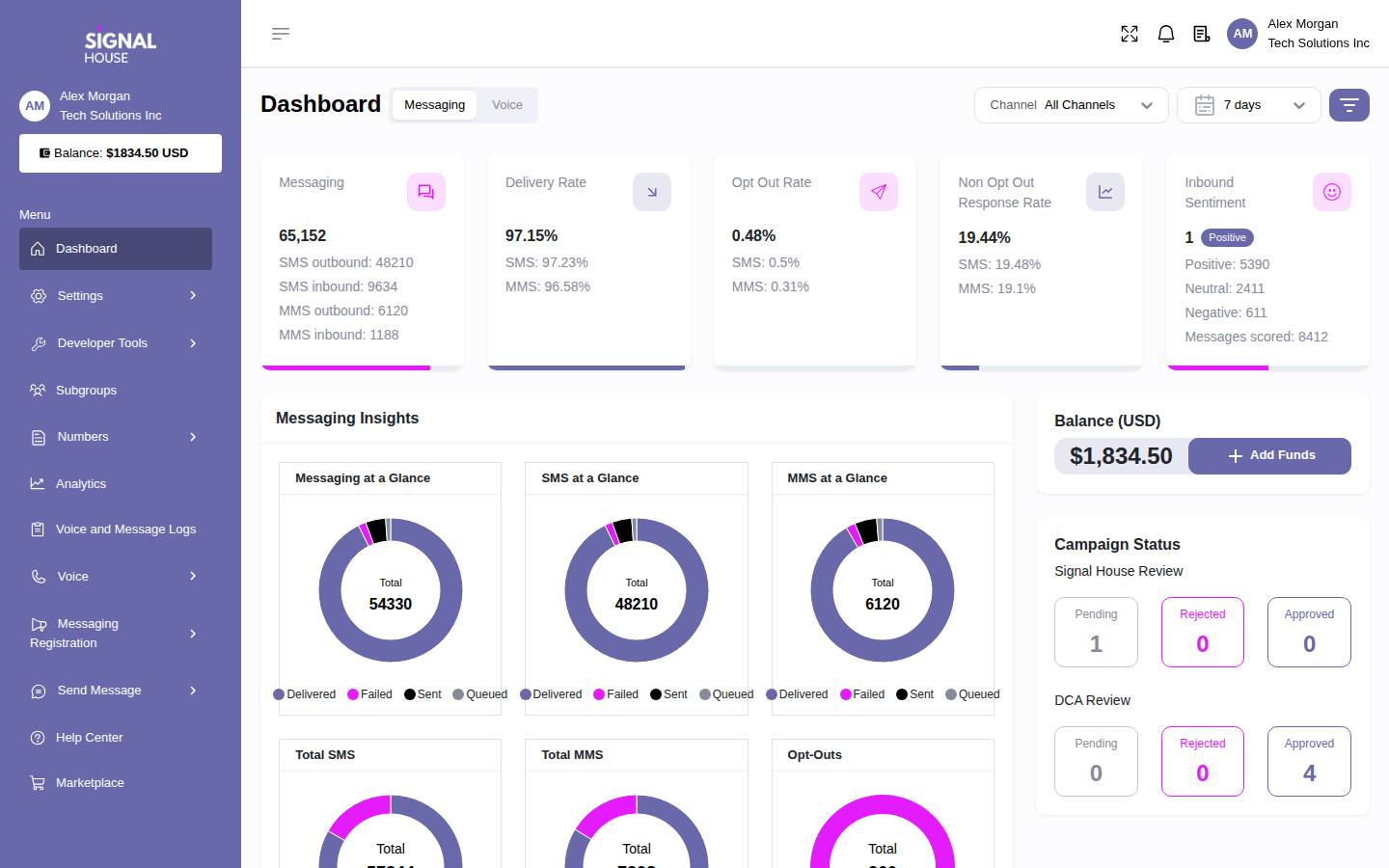
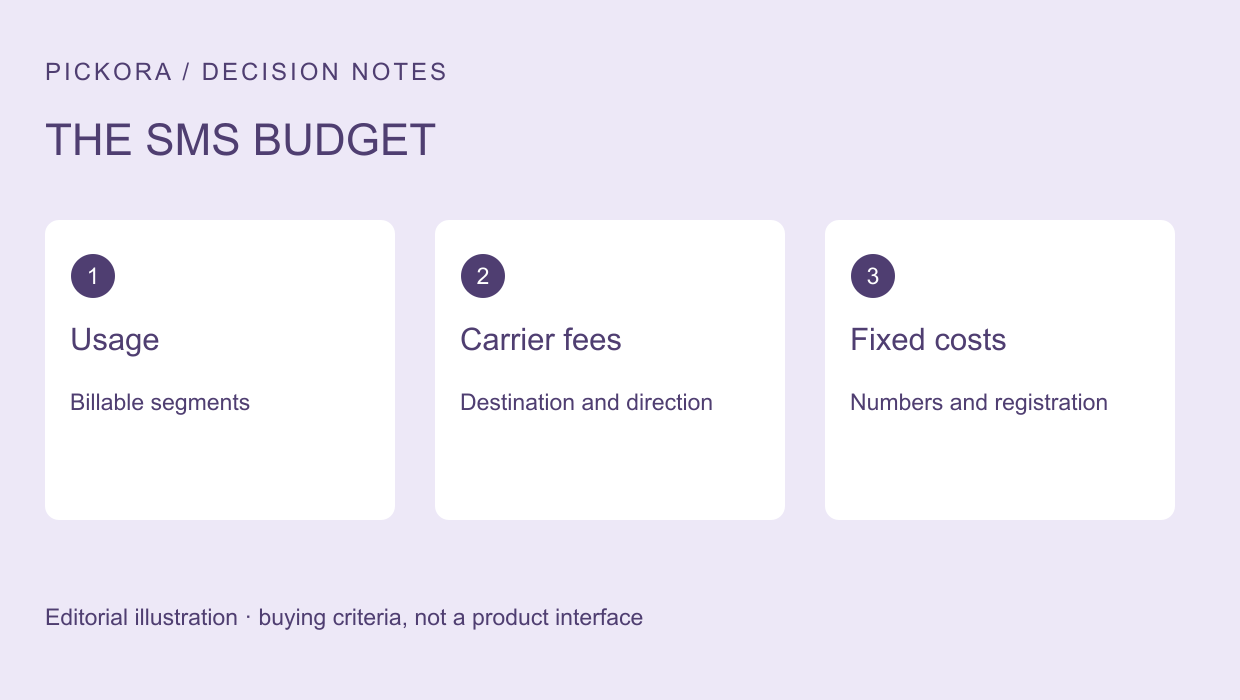
This guide uses Signal House’s US rate card and Twilio’s SMS encoding documentation, checked November 4, 2026. Pickora has not sent this example traffic. All calculations below are illustrations, and the cover is an editorial diagram. The portal image is an official vendor demonstration.
Layer one: count the segments
Twilio’s encoding documentation explains the usual SMS limits: a single GSM-7 segment can carry up to 160 characters, while UCS-2 allows 70. Multi-part messages have lower per-segment capacity. Some characters, including many emoji, can change the encoding and the segment count.
Do not estimate from the character count in a spreadsheet alone. Check the exact message text with the provider’s tooling and verify the billed behavior in a small trial. Personalization, links and translations may change the length. The technical reference explains segmentation; it is not a Signal House invoice guarantee.
Layer two: add carrier charges
The Signal House rate card lists local 10DLC outbound SMS at USD $0.0065 per segment with no minimum. Its separate outbound carrier charges include $0.0035 for AT&T and $0.0045 for Verizon and T-Mobile. Rates were checked on the source date and should be reconfirmed before purchase.
For an arithmetic example, assume 10,000 outbound single-segment messages, all to Verizon destinations at the displayed local 10DLC rate. Base usage is $65 and the carrier component is $45: $110 before numbers, registration, inbound traffic, taxes and other applicable charges. This deliberately simplified carrier mix is not a forecast of your audience.
If each message instead occupies two billed segments at those same assumed rates, the variable cost becomes $220. The recipient count has not changed; the billable volume has. Shortening a message can affect cost, but clarity and the required content still matter.
Layer three: numbers and setup
The same rate card lists a local number at $1 per month in its no-minimum band. One number would bring the first example to $111 before the excluded charges. Larger number inventories, a different sender type or negotiated terms change the calculation.
Ask for the complete current registration-fee schedule and any recurring campaign charges in writing. A complete registration quote was not verified for this guide, so those charges remain outside the example total. A cost comparison is incomplete until those charges are known.
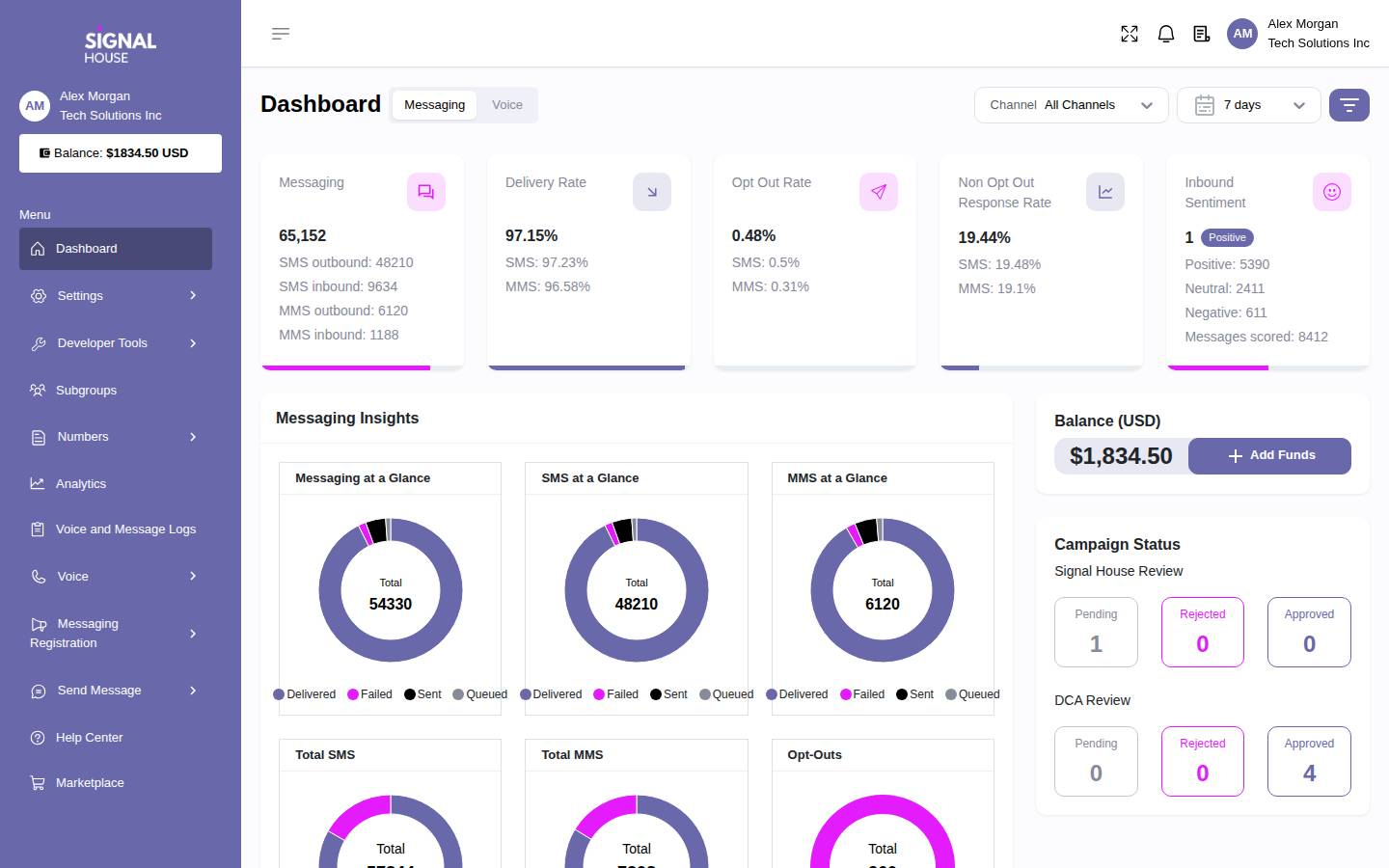
Vendor demonstration visual. Source: Signal House. This is not a Pickora test account.
Use the vendor dashboard example to ask where you will see traffic and spend. Its displayed balance and delivery figures are demonstration data, not the cost or outcome of this worked example.
Layer four: replies and the operating workflow
Estimate incoming traffic separately. A two-way support conversation has a different pattern from a one-way notification. Record which inbound platform and carrier rates apply to your selected sender, rather than applying the outbound number to everything.
Add the cost of integration, monitoring and handling failed or duplicate work. A successful API request and a useful recipient outcome are different checkpoints. Ask how your system learns about a failure and prevents an uncontrolled retry loop from increasing spend.
Compare providers with the same worksheet
Use columns for sender type, destination, outbound segments, inbound traffic, number rental, registration, recurring fees, support and tax. Apply each provider’s rates to the same assumptions. Treat a savings headline as a question to calculate, not a discount guaranteed for your workload.
Before scaling, compare a small trial’s actual bill with the estimate and explain any difference. The cheapest relevant offer is the one whose complete cost and workflow meet the requirement; a low isolated unit rate cannot establish that on its own.
Continue with this topic
Useful resources
Signal House
One documented option discussed in this guide; assess the relevant plan and workflow.
Pickora may earn a commission if you buy through this link. Read our disclosure.