At a glance
Useful to evaluate as one input to a human writing-review process. Its scans and process tools answer different questions, and a detection result should never become a standalone authorship verdict.
GPTZero
Best for: Editors building a documented review process; Educators evaluating writing evidence alongside conversations
Evaluate GPTZero AI detection, sentence highlights, Writing Replay and plan limits without confusing an AI probability with proof of authorship.
Strengths
- Sample results provide sentence highlights and explanatory signals
- Writing Replay offers a separate view of the writing process
- Free and paid tiers have published allowances
Trade-offs
- False positives and false negatives remain possible
- Short excerpts provide less context than full documents
- Web plans, API access and data handling need separate checks
Pickora may earn a commission if you buy through this link. Read our disclosure.
What would you do with the result?
GPTZero becomes easier to assess once you define the action that follows a scan. An editor may want to ask a writer about a passage; an educator may want to understand how an assignment developed. Neither task is solved by treating a number as proof of who wrote the document.
This is a research-based review of GPTZero’s public product, pricing and FAQ pages, checked November 4, 2026. Pickora has not benchmarked detection accuracy, tested a paid account or compared detectors on a controlled dataset. The visuals are vendor samples, not results obtained from our own documents.
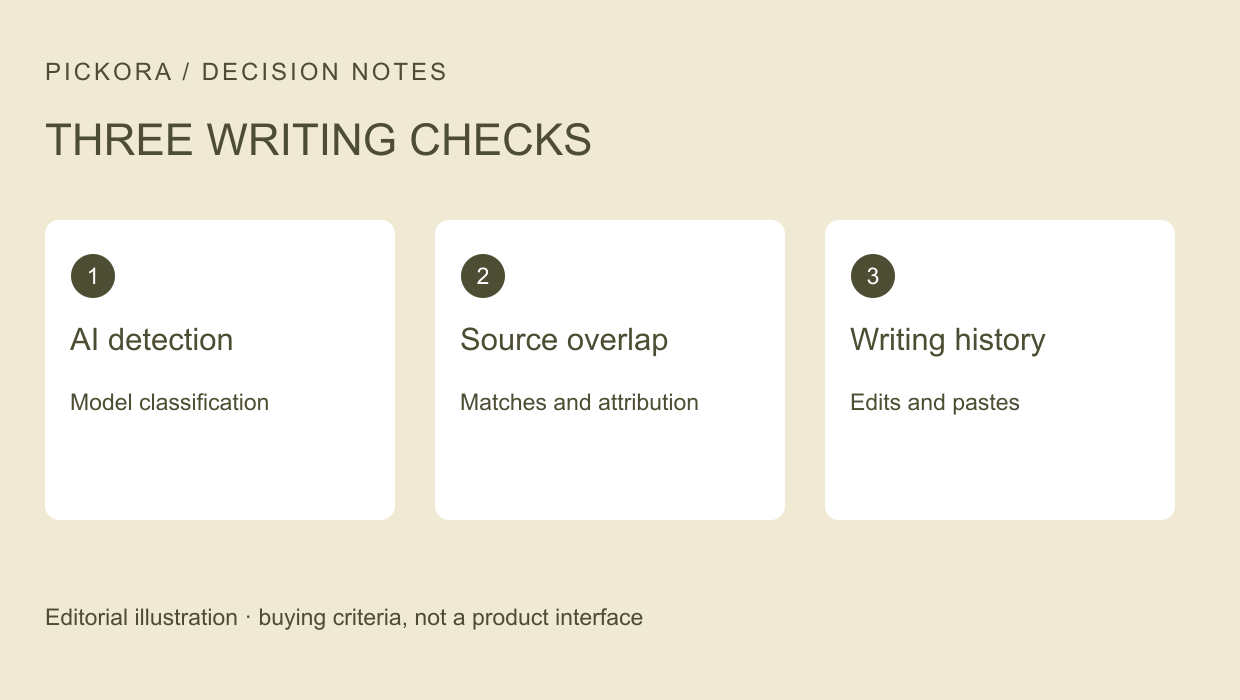
AI detection is a classification task
The GPTZero FAQ describes a system that looks for possible AI-generated text. It explicitly acknowledges both human writing classified as AI and AI writing classified as human. The company recommends further inquiry and says detection results should not be used to punish students.
That limitation changes how we would use the product. A flagged report can identify a question for a reviewer to investigate. It cannot establish an author’s intention, the permissions granted by an assignment or whether assistance was disclosed. Those depend on evidence and policy outside the detector.
The product homepage publishes strong accuracy claims. We do not reproduce them as Pickora findings or translate them into a promise for your documents. Language, document type, text length and editing can all change the relevance of an evaluation.
Sentence highlights help locate a question
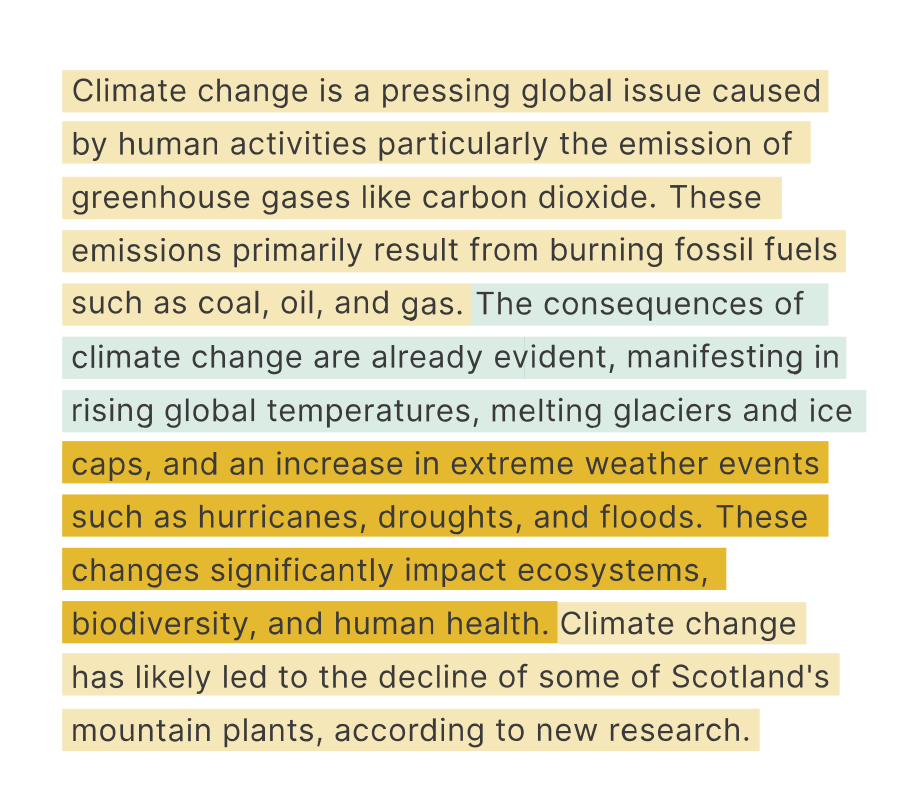
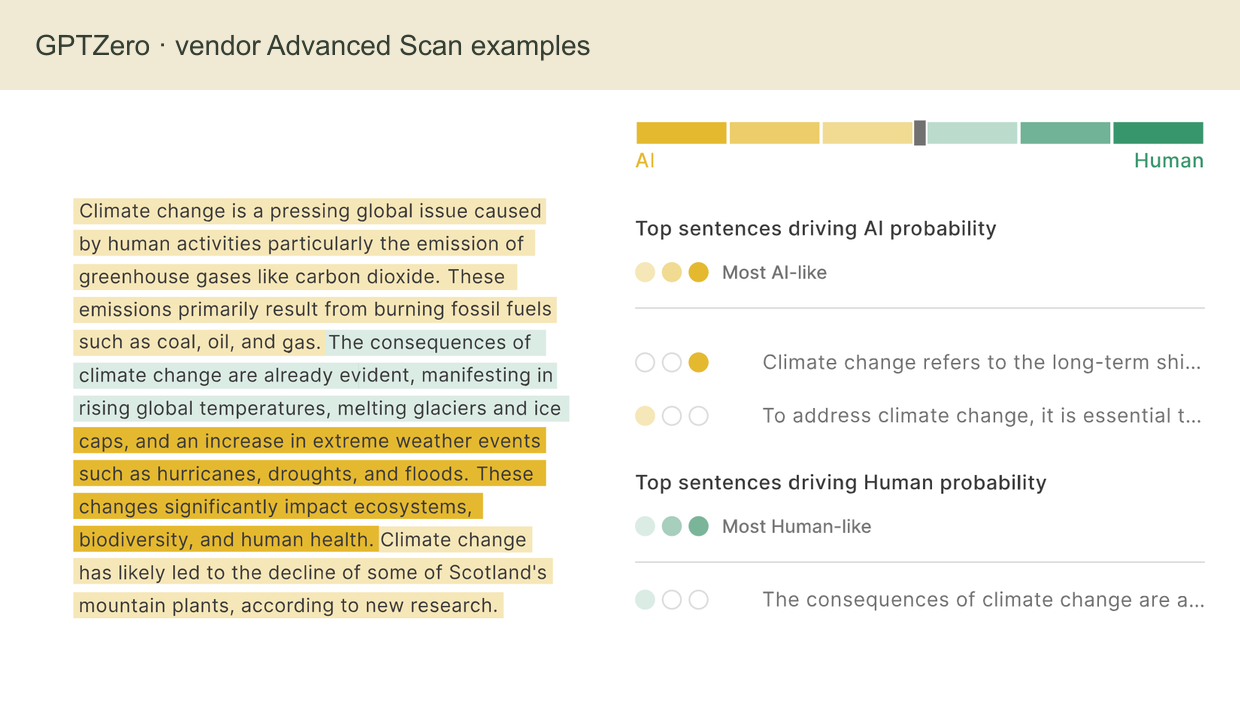
Vendor demonstration visual. Source: GPTZero. This is not a Pickora test account.
The homepage’s Advanced Scan samples show highlighted passages and signals contributing to a classification. They can help a person choose what to read more carefully. A highlighted sentence is still a model output; it is not a source citation or a record of an author’s keystrokes.
Read the surrounding paragraph before asking a question. Templates, quotations, technical wording and shared assignment prompts require context. The FAQ states that document-level classification is more reliable than paragraph or sentence classification, so isolating a highlighted line can discard useful context.
Writing Replay provides a different kind of information
Vendor demonstration visual. Source: GPTZero. This is not a Pickora test account.
Writing Replay and Writing Reports are presented as ways to inspect the writing process, including edits and pastes in supported environments. They should be assessed separately from a classifier that reads final text.
A pasted paragraph is an event to understand, not automatic evidence of misconduct. Someone may have drafted in another editor, used an accessibility workflow or pasted a properly attributed quotation. Ask what the activity represents and whether the relevant history was captured. The presence of a replay should not be interpreted as a guarantee that all writing activity is visible.
Plans: words per month and characters per scan
The pricing page lists Free with 10,000 words per month, Premium with 300,000 and Professional with 500,000. The retrieved annual view displays USD $12.99 per month for Premium and $24.99 for Professional, billed annually. Those correspond to $155.88 and $299.88 per year before any applicable tax; they are not monthly payment quotes. Verify the current checkout and billing selection.
Monthly word allowance is only one constraint. The published per-scan character limits are 10,000, 50,000 and 150,000 respectively. Check both the largest document and the total workload. The page advertises larger batch capacity at higher tiers; confirm what the selected plan actually includes rather than assuming an FAQ’s general upload statement applies to Free.
API access has a separate pricing path. A browser subscription should not be treated as an unlimited integration license. For institutional purchasing, also confirm team administration and the exact features in a written quote.
Data handling belongs in the evaluation
The FAQ distinguishes API processing from dashboard inputs and describes different retention behavior. Read the current policy for the route you will use before uploading confidential or student material. Do not generalize an API statement to every web interface.
Our evaluation would begin with approved, non-sensitive documents and a written review process. Record the questions the output helps answer, the ones it cannot answer and how a writer can supply context. These are suggested evaluation steps, not completed Pickora tests.
GPTZero is worth examining if its outputs support a careful human process. It is a poor fit for a workflow that intends to accuse, reject or grade someone from a detector score alone. Buy additional capacity only after the free entry point and the documented features demonstrate a clear use in your own review process.